
Practice
Reiki develops through daily practice.
After Level 1, students are given a clear structure to follow at home. The same method learned in class is continued through self-treatment and the daily practice of the Precepts. This is where the system begins to take hold.
Daily Self-Treatment
Students are instructed to practice self-treatment each day. The standard approach is ten positions per day, with approximately three minutes per position. This creates a consistent rhythm of practice and ensures that the whole body is treated regularly over time.
Some days the full sequence is completed, and other days fewer positions are practiced. When tired, it is enough to place the hands on a few positions and continue as long as possible, and it is not uncommon to fall asleep with the hands in place. At other times, the practitioner may continue for longer periods, treating continuously while resting or watching a movie.


The Precepts
Alongside self-treatment, the Precepts are practiced each day. They are recited at least twice daily, and more often when needed.
Just for today
Do not anger
Don’t worry
Be grateful
Work diligently
Be kind to others
These shape how the practitioner meets daily situations. As self-treatment develops through the hands, the Precepts refine behavior in real time.
Sensitivity Develops Through the Hands
As practice continues, students begin to notice differences between positions. Certain areas of the body begin to take more Reiki, and the hands naturally remain longer in those positions. This is not something the practitioner decides in advance, but becomes clear through contact.
For many students, this appears first in the head. The hands may stay longer on the forehead or temples, often corresponding to patterns of thinking and worry. When students remain in those positions, they report that their mind becomes clearer and that worry begins to settle. When the back of the head consistently draws more attention, students often report improved sleep after a period of continued treatment.
When the stomach takes more attention, students who continue treating that area over several weeks often report improvement in digestion.
The hands indicate where to remain, and the instruction is simple: stay longer.

The Hands Guide Timing
At the beginning, students often try to follow time strictly by using a timer or music with a bell at the desired interval. With practice, timing begins to shift naturally.
Some positions feel complete quickly, while others require more time. The practitioner learns to recognize this through the hands rather than through analysis. The structure remains in place, and within that structure, the hands begin to guide the duration of treatment.
Practice With Others
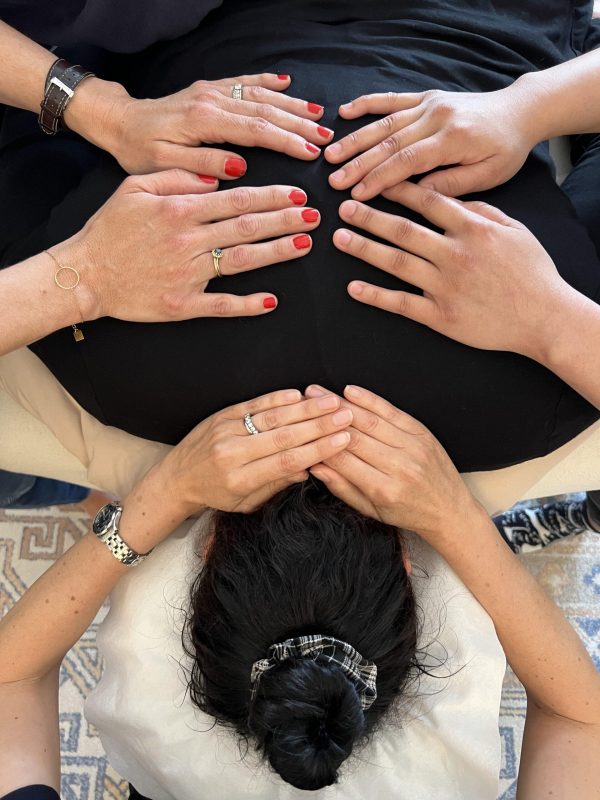
When possible, students are encouraged to treat others. Not all students have this opportunity regularly, but when it is available, it supports the development of the practice and reinforces what is learned through self-treatment.
Reiki circles provide another environment for continued practice. These allow students to repeat the method, receive treatment, develop relationships with other practitioners, and remain connected to the system over time.
Practice Continues
Practice is established through continuity, not through completing a perfect routine each day. Some days are shorter, some are longer, and the experience of practice varies. The practitioner returns to the structure and continues.
Over time, repetition establishes familiarity with the method. The hands become more stable, attention settles more easily, and the need to manage the experience decreases. Development occurs through continued practice.
Practice Within the System
Practice connects all parts of the system. Foundations establish daily discipline, treatment provides the structure, training provides guidance and correction, and initiation reinforces connection. Through repetition, these elements come together and allow the system to function as a whole.