Training
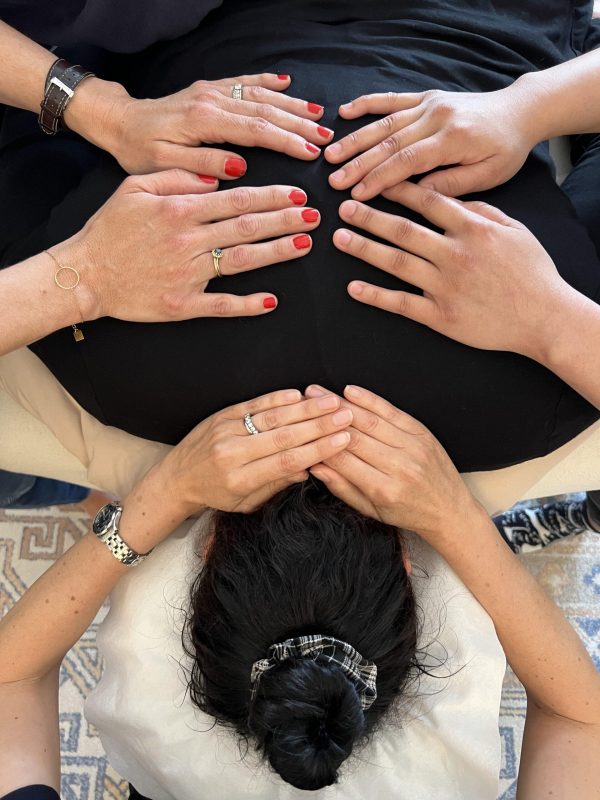
Reiki is taught through demonstration, explanation, and direct practice. In each section of class, a student volunteers to lie on the massage table as the demonstration subject. The teacher makes the student comfortable using a pillow, a bolster, and a sheet or blanket if needed, along with a tissue over the eyes and forehead to maintain cleanliness. The teacher then stands at the side of the table, facing the class, and begins the treatment, demonstrating each hand position in real time.
While the hands remain in place, the teacher explains what is being treated, how the systems of the body respond, and what is commonly observed in practice. These explanations include examples from actual treatments, describing how certain positions take more Reiki and what changes are often seen over time. Students see the position as it is held and hear how it functions while it is being demonstrated, and then practice the same positions on each other. Understanding begins through what is shown and explained in contact and becomes clear through what is felt in practice.

The Teacher Establishes the Connection
Alongside demonstration and guided practice, the teacher performs initiation, often called attunement and known in Japanese as reiju. Reiju is given from the hands of the teacher directly to the student and cannot be performed by the student alone. This connection is established in person and is not transmitted through books, recordings, or other media. Through reiju, the student is connected to Reiki in a way that allows the practice to function as it is taught within the system.
The Method Is Learned Through Repetition
Each section of class follows the same pattern. The teacher demonstrates the positions in contact while explaining their function, and students then practice those same positions on each other. Through this repetition, the structure of treatment becomes familiar, and students learn how to place their hands, how to remain in position, and how to move through the sequence.
With each repetition, the method becomes more stable. This same structure continues after class through daily self-treatment and ongoing practice.
The Teacher Helps the Student Recognize What They Feel
During practice, the teacher observes and guides each student. Many students are unsure what they are feeling when Reiki begins to flow through their hands, and this is a normal part of training. The teacher helps the student recognize and acknowledge what is already present, guiding their attention to the experience rather than toward interpretation.
The sensations vary between students. Some feel heat, others feel tingling or a cool sensation, while some describe a current or electrical quality or a sense of magnetism between their hands and the body. A few may see light or color, and others may notice an emotional response.
The specific sensation is not important. What matters is that the student becomes aware of it, recognizes how it appears for them, and begins to understand what it means within the context of treatment through repeated practice.
The Hands Provide Clear Instruction
As students begin to recognize these sensations, they also begin to understand what they mean. A clear sensation indicates that Reiki is flowing, and the instruction is to remain in that position. When the sensation becomes strong, more time is needed, and the student stays longer. When the sensation stops, the treatment in that position is complete.
This is how timing develops within the system. The practitioner does not decide in advance how long to remain, because the hands provide that information directly through the experience.
Training Requires Guidance
This process develops through guided practice. Students learn to recognize what they feel through direct experience, supported by observation and questioning from the teacher. Through this guidance, the system becomes clear and consistent, and the student gains confidence in what they feel and how to respond to it.
Training Continues Through Practice
After class, students continue practicing through daily self-treatment and repetition of the method, maintaining the same structure they were shown during training. Reiki circles and continued contact with the teacher support this process by providing opportunities to practice, receive treatment, and remain connected to the system over time.
As practice continues, the student becomes more familiar with the method and more stable in attention and contact.
Levels of Training in Koshin Reiki
Training in Koshin Reiki is organized into stages that reflect the development of practice over time.
♦ First Degree (Shoden)
Hands-on Reiki practice for oneself and others. This level establishes the foundation of treatment and daily Reiki discipline.
♦ Second Degree (Okuden)
Distance treatment, mental treatment, and the internal practices of Usui Shiki Ryoho. Students learn the deeper applications of Reiki in daily life and in treatment.
♦ Reiki Master Practitioner (Shinpiden)
Advanced practice and integration of the system. Students deepen their discipline and prepare for the responsibilities of mastery.
♦ Reiki Master Teacher (Shihan)
The teaching level of Koshin Reiki. Shihan are authorized to initiate students and carry the lineage forward.

Training Within the System
Training connects all parts of the system. Initiation establishes the connection, treatment provides the structure, and practice develops through repetition, while the teacher provides guidance and correction throughout. Together, these allow the system to function and develop over time.